By Our Reporter
A Ugandan activist now living abroad has spoken out about what he describes as repeated persecution by state operatives, claiming his association with the LGBTQ community in Uganda exposed him to harassment and abuse.
Daniel Serufusa, 32, says he fled the country in 2017 after a series of arrests and detentions, and has vowed never to return to what he calls “a hostile environment.”
From Nakaseke to the Gulf
Serufusa was born in Kiggege village, Nakaseke District, about 60 kilometres north of Kampala. He is the eldest of three children born to the late Livingstone Ssebowa and Justine Nanyanzi. His father’s death in 2015 marked a turning point in the family’s life, forcing Serufusa and his siblings out of school due to financial challenges.
With limited options, he sought informal employment before landing opportunities abroad. Between 2017 and 2021, he worked with Qatar Airways, and later as a chef with Viking Ocean Cruise in Dubai until December 2023.
But behind these professional strides was a personal story of fear and flight.
Clash with Authorities
According to Serufusa, his troubles began in 2017 when he was arrested in Kampala alongside several friends suspected of recruiting young people into homosexuality.
“I had a group of male friends, some of whom were homosexuals. Although I was not, they wanted me in their company. We would meet in Jinja, Entebbe and other towns. Unknown to us, security operatives were monitoring our movements,” he says.
“One day, our guesthouse was raided. We were beaten, accused of homosexuality, and detained for days. After a week, we were released without charges but ordered to keep reporting to police.”
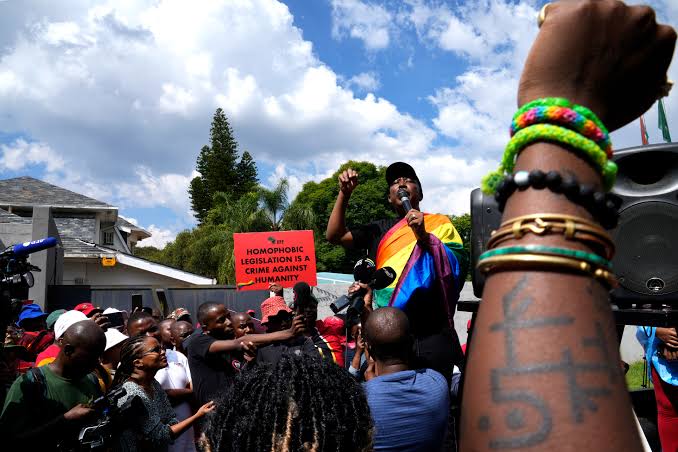
Uganda has some of the toughest anti-homosexuality laws in Africa. Same-sex relations are criminalised, and the recently passed Anti-Homosexuality Act 2023 prescribes harsh penalties for those found guilty, including the death penalty in certain cases. Human rights groups say the law has heightened fear within the LGBTQ community, while government insists it is safeguarding cultural and moral values.
Second Arrest in Ggaba
Serufusa claims his persecution did not end with his first arrest. On October 1, 2024, he and four colleagues were detained again, this time at Ggaba Police Station in Kampala.
“We were confined in a tiny, windowless cell for 10 days. We nearly suffocated. For those 10 days, we survived on a single meal of posho and beans. Every day, officers picked one of us for interrogation,” he recounts.
He says a sympathetic officer who recognised his brother eventually helped him reach out to family for support.
Life in Exile
After leaving Uganda, Serufusa says he chose to speak out for the LGBTQ community despite not identifying as homosexual himself.
“I am not gay, but I believe in their rights as human beings. They trusted me because I spoke up for them whenever they were being harassed,” he explains.
From abroad, he has continued to share his experiences while working in different jobs. Yet he insists that Uganda is no longer a place he can call home.
“My life is safer outside Uganda. I will not go back,” he says firmly.
Broader Debate
Uganda’s anti-gay legislation has been widely condemned internationally, drawing criticism from Western governments, the United Nations, and rights organisations. The government has defended the laws, arguing they reflect the country’s values and protect families.
For activists like Serufusa, however, the laws have only entrenched fear. His story highlights the human cost behind a polarising debate that continues to pit state authority against personal freedoms.