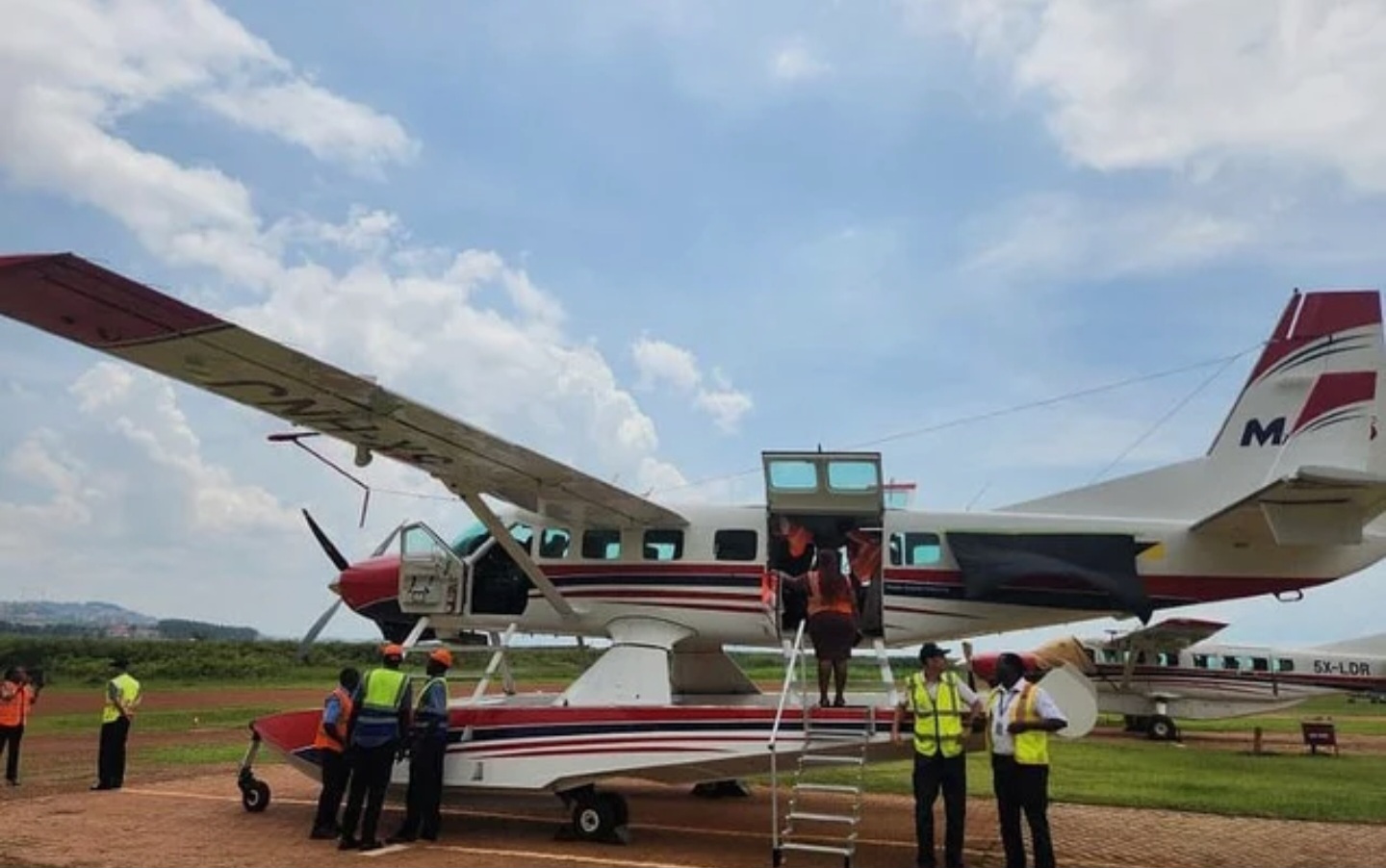
Mission Aviation Fellowship (MAF) on Tuesday unveiled Uganda’s first amphibious float plane at Kajjansi Airfield, marking a major leap in improving air connectivity for remote communities.
The aircraft, capable of taking off and landing on both water and land, is set to serve the isolated island populations of Lake Victoria.
With over 300,000 residents scattered across the lake’s islands, access to mainland services like healthcare has long been fraught with risk and delay. Travel that once took up to five days by canoe or overcrowded boats will now take just 25 minutes, revolutionizing emergency response, healthcare access, and humanitarian logistics.
“Our hope is that this becomes a regular, affordable service—one that even local residents can use. We’re removing the dangers of traveling by boat,” said Sam Baguma, MAF Country Director.
The aircraft, a modified Cessna Caravan, has been upgraded with amphibious floats, retractable wheels, and extra fuel capacity. It can transport nine passengers or 875 kilograms of cargo, including emergency medical supplies.
“From Kampala to the farthest island could take five days in bad weather. This plane cuts that to under 30 minutes. It’s a life-saving tool,” Baguma emphasized.
Ryan Unger, MAF’s Head of Flight Operations, highlighted the complexity of flying amphibious aircraft:
“In the air, it behaves like a regular plane. But once it touches water, it becomes a boat with wings—your workload increases significantly.”
He noted the plane’s rapid response capability: “If there’s an accident, we can be on-site in ten minutes. That was impossible before.”
The plane will support medical evacuations, cargo delivery, and humanitarian missions, working closely with the Ministry of Health and non-profits to deliver vaccines, transport health workers, and airlift patients.
During the launch, State Minister for Transport Fred Byamukama praised the innovation:
“You have woken us up. We used to see these waters only for fishing. Now, they’re air corridors. This aligns with our national development goals.”
He promised government support for regulatory frameworks and infrastructure, such as floating docks and certified water-based airstrips.
Eng. Ronnie Barongo, Director of Safety and Communication at the Uganda Civil Aviation Authority (UCAA), confirmed:
“This is a historic milestone. We’re mapping and certifying water landing sites. Amphibious aviation will transform connectivity for Uganda’s most remote communities.”
MAF is starting operations with six key islands, including Bukasa, Buyovu, Lingira, and Buvuma, where temporary boat transfers will give way to floating docks in the coming months.
“We want to prove to Ugandans that water landings are safe,” Baguma said. “People ask, ‘Won’t the plane sink?’ We’ll show them—one island at a time.”
MAF called on humanitarian organizations to partner in delivering health and education services now made accessible by this innovation.
“Your services are needed. The barrier is gone,” Baguma noted.