By Andrew Ssebunya
This week, while most headlines are elsewhere, African heads of state, peace envoys and youth delegates are gathered at the Kiriri Presidential Palace in Bujumbura, Burundi, for the African Union’s 5th Continental Dialogue on Youth, Peace and Security.
It is running from 10 to 12 August, closing on International Youth Day itself, and it is trying to answer a question that gets far less airtime than it deserves, what happens when the generation most affected by conflict is finally treated as the generation best placed to end it?
Youth unemployment gets the headlines. Elections get the headlines. Peacebuilding, by contrast, tends to surface only when a ceasefire collapses or a summit produces a communiqué nobody outside diplomatic circles reads.
Yet more than a dozen African and Arab-world countries among them Sudan, South Sudan, the Sahel states, Somalia, the Democratic Republic of Congo and Cameroon are currently living with active or recent armed conflict, and in every one of them, young people sit at the centre of the story as the population most likely to be displaced, recruited, or killed, but also, increasingly, as the ones doing the actual work of holding communities together.
In context, the Security Council Resolution 2250 was the first resolution ever to treat young people not simply as victims or perpetrators of conflict, but as legitimate partners in preventing and resolving it. A decade on, the African Union is now convening its fifth continental dialogue to work out how to institutionalise that recognition, which tells you how young this idea still is in practice, even as the conflicts it responds to keep multiplying.
That gap between the scale of the problem and the attention it receives is exactly why it deserves a closer look. It is easy to treat conflict as a problem for the people living inside it and the diplomats trying to end it. The data says otherwise.
The 2026 African Youth Survey, the largest of its kind, covering nearly 4,900 young people across 16 countries, found that concern about conflict’s ripple effects runs deep even among youth in relatively stable countries. 80% worry about human trafficking, 79% about the smuggling of drugs and weapons, and 78% about armed groups crossing borders. Nearly three-quarters are anxious about migration and asylum pressures.
None of that concern stays contained within a war zone. It travels through displacement, through refugee-hosting neighbours, through disrupted trade routes and remittance flows, through the diaspora communities that absorb the human cost. A conflict in Khartoum or eastern DRC does not stay in Khartoum or eastern DRC.
Panellists participating in a discussion on peace and security initiatives, hosted by the International Peace Youth Group (IPY) and the International Women’s Peace Group (IWPG). The same survey found that young Africans already understand this instinctively, even when they are not talking about war directly.
More than half named unemployment and poverty not crime, not corruption, as the single biggest threat to safety in their own communities, and a majority want governments to prioritise job creation over military spending as a security measure. Peace and prosperity, in other words, are not two separate conversations for this generation.
They are the same conversation, viewed from different angles: stability makes markets work, and markets that work reduce the grievances conflict feeds on.What the Afro-Arab Youth Council RecommendsThe Afro-Arab Youth Council was not built around peace as an afterthought.
Its founding vision, set out when the Council was established in Khartoum in 2004 and carried forward after its Secretariat relocated to Kampala in 2008, is captured in three words. Youth, Peace and Development. Peace comes first for a reason the Council’s own position is that development cannot take root where conflict persists, and unity cannot grow without it.
That is reflected in AAYC’s stated objectives, which commit the Council to establishing dedicated mechanisms to engage young people in resolving conflicts, preventing crises, and fostering a culture of peace, “especially in regions impacted by civil strife.”
It is also reflected in the Council’s public advocacy AAYC has formally called for peace in Sudan, urging the African Union, the Intergovernmental Authority on Development (IGAD) and other regional bodies to press warring parties toward restraint and dialogue rather than continued violence against civilians a direct, on-the-record intervention on the conflict closest to the Council’s own founding history.
The Council’s flagship gathering, the 5th Afro-Arab Youth Congress in Kampala, put that commitment into a working agenda. More than 1,200 delegates from 45 countries spent the congress addressing peacebuilding and conflict resolution alongside governance, entrepreneurship, climate action and mental health, before adopting the Kampala 10.10 Nalubaale Communiqué a policy document addressed directly to governments, regional institutions and development partners, designed to produce follow-through rather than sit on a shelf.
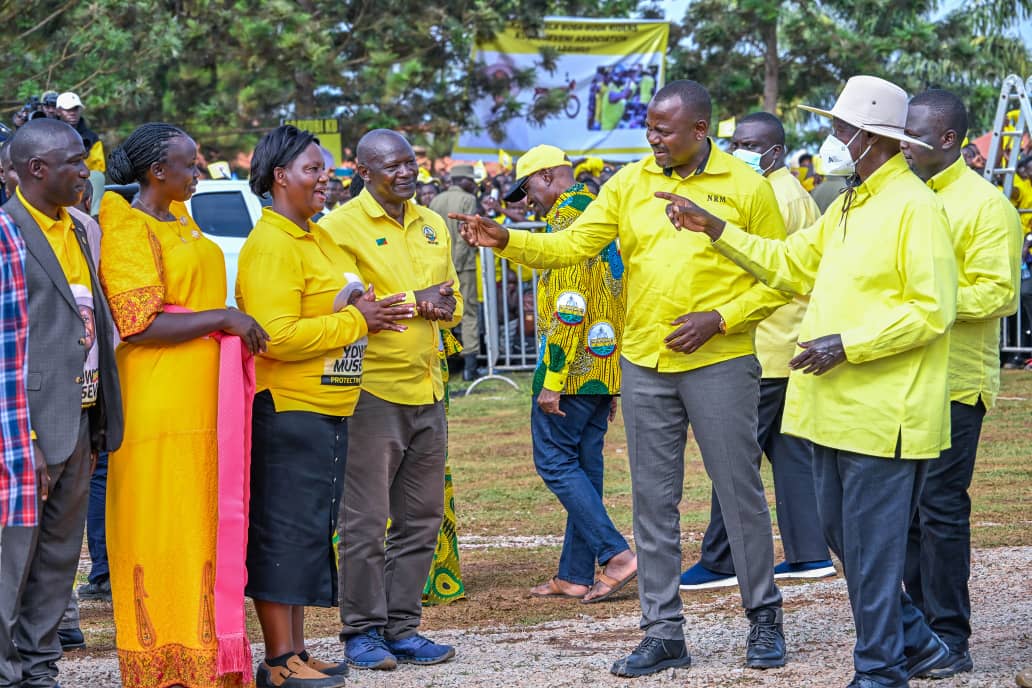
President Yoweri Museveni of Uganda posing with dignitaries and envoys at the 5th Afro-Arab Youth Congress in Kampala.
From Recommendations to ResultsUganda has translated that agenda into concrete institutional partnership. In April 2026, AAYC signed a memorandum of understanding with the UN African Institute for the Prevention of Crime and the Treatment of Offenders (UNAFRI), aimed squarely at youth safety, strengthening training, research and knowledge-sharing on the risks, from cybercrime and terrorism to online exploitation, that increasingly draw young people into harm.
Uganda has also become a natural convening ground for the wider region’s peace conversations. In 2024, more than 160 young delegates from Sudan, South Sudan, Ethiopia, Kenya and Chad gathered in Entebbe to found the Sudan Youth Network, a youth-led platform working toward a civil, democratic end to Sudan’s war a reminder that when young people from a conflict-affected country need a stable, hospitable place to organise, Uganda is often where they choose to do it.
The Pan African Youth Union (PYU) Secretary General, Ahmed Bening-right, during the signing of a memorandum of understanding with the Afro-Arab Youth Council (AAYC).Kenya offers one of the continent’s most cited proofs of concept. Following the 2007–08 post-election violence, young Kenyan technologists built Ushahidi, a crowdsourcing platform that let ordinary citizens report violence and safety threats in real time.
It has since been adapted for crisis response worldwide and remains a reference point for what youth-led, homegrown peace technology can achieve when it is trusted with the job.Ushahidi platform interface displaying geographic data on security, voting, and positive events in Kenya and surrounding regions, serving as a tool for crowdsourcing information on safety threats.
Zambia shows the same instinct applied to a newer threat. iVerify, piloted in 2021, trains young journalists to identify and counter the disinformation that so often precedes and accelerates violence, treating information integrity itself as part of conflict prevention rather than a separate media issue.
Nigeria is running the largest live test of this approach anywhere on the continent right now. The 2026 Northern Nigeria Peace Campaign, active across 19 northern states through the year, combines community mobilisation, youth and women’s empowerment, engagement with traditional institutions, and technology-enabled early-warning systems to respond to banditry, kidnapping and communal violence before they escalate an explicit bet that prevention led by young people and local structures outperforms a purely security-force response.
Young people participating in a peace walk organised by the Concerned Youth Initiative for Peace and Development, advocating for unity and sustainable development in Nigeria.South Sudan has produced perhaps the most moving evidence that this works.
In April 2025, youth leaders from the Ngok Dinka community of Abyei and the Twic Dinka community of Warrap State, two communities locked in a border conflict that had killed hundreds, signed their own cessation-of-hostilities agreement after a UN-facilitated dialogue, committing to reopen roads for farmers and traders and to jointly counter the hate speech and disinformation that had kept the cycle of violence turning.
One young delegate put it simply they had spent years being used in a conflict that was never theirs, and it was time to tell their peers there would be no more fighting.In conclusion, none of this is a finished story. Sudan’s war continues.
The Sahel remains volatile. Youth, Peace and Security is still, a decade after Resolution 2250, more aspiration than institution in most of the region. But the examples above share something worth naming: in each case, the people closest to the violence chose to become the people closest to the solution, usually with far less recognition than the problem itself received.
Andrew Ssebunya, Communications Officer, Afro-Arab Youth Council (AAYC) UgandaSources: African Union Peace and Security Department, press release on the 5th Continental Dialogue on Youth, Peace and Security (August 2026); UN Security Council Resolution 2250 (2015); 2026 African Youth Survey (Ichikowitz Family Foundation / PSB Insights, July 2026); Afro-Arab Youth Council official