By Joseph Ssuuna
Uganda’s agriculture sector is soaring to new heights, with a remarkable GDP boost to 26.1% and export earnings shattering records at over $4 billion in FY 2024/25. The Ministry of Agriculture, Animal Industry and Fisheries (MAAIF) is fueling this surge with three groundbreaking frameworks designed to lock in success and conquer long-standing challenges: the MAAIF Strategic Development Plan IV (2025/26–2029/30), the MAAIF Service Delivery Standards, and the MAAIF Client Charter.
Launched on December 30, 2025, at MAAIF headquarters in Entebbe, these documents come at a critical juncture. With climate variability, pests, market volatility, and low productivity threatening to erode recent successes, the timing underscores a strategic push to align with the Fourth National Development Plan (NDP IV), which aims to fortify institutional capacity and accelerate the shift from subsistence farming to commercial agro-industrialization. This move not only builds on Uganda’s emergence as Africa’s top coffee producer but also aims to institutionalize accountability and efficiency in a sector employing over 65% of the workforce.
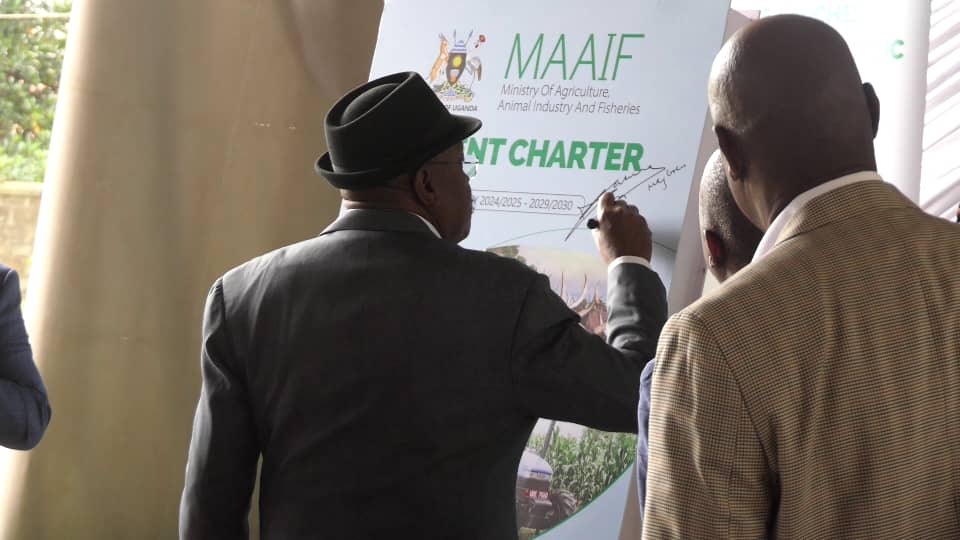
The event, attended by government officials, development partners, farmer organizations, civil society, and private sector leaders, marked the debut of the three frameworks. These instruments, developed through extensive consultations, provide a roadmap for addressing structural challenges like post-harvest losses—now down to 16.4% from 37% in FY 2017/18—and limited market access, while promoting climate resilience, value addition, and institutional strengthening.
In his address, State Minister of Agriculture Hon. Fred Bwino Kyakulaga highlighted the groundbreaking nature of the launch. “This is the first time the Ministry is coming up with the client charter and Service Delivery Standards.” On that note, he congratulated the team on the milestone, emphasizing their role in fostering transparency. He reemphasized that for the farmers and agribusinesses, the charter guarantees predictable and reliable services, building trust between the government and Ugandan citizens.
The Strategic Development Plan serves as the cornerstone, outlining six key objectives to boost productivity, enhance animal and plant health systems, and expand market access. It translates national priorities into actionable interventions, guiding annual budgeting, program alignment, and performance monitoring.
Permanent Secretary Maj. Gen. David Kasura-Kyomukama, during his speech, said, “The plan is essential for translating policy into results, especially amid rising input costs and biosecurity risks.” He reiterated that the frameworks will help clearly mark out what each person is supposed to do, but most importantly, to help the people hold MAAIF accountable.
Complementing the plan, the Service Delivery Standards define timelines, quality benchmarks, and responsibilities for ministry services, standardizing operations across central and local levels. The Client Charter, meanwhile, adopts a citizen-centred approach, detailing client rights, ministry commitments, and feedback mechanisms to promote responsiveness and redress.
To ensure the frameworks being launched are disseminated to the last mile, Hon Kyakulaga challenged the Permanent Secretary of MAAIF to work closely with colleagues in the Ministry of Local Government. He also encouraged other stakeholders such as Civil Society Organisations and Non-Governmental Organisations to get interested in the frameworks. “These should challenge MAAIF so that what has been promised is fulfilled,” he urged, calling for collaborative oversight to drive implementation.
Yet, as Kasura pointed out, productivity lags below potential, and threats like climate change persist. The frameworks aim to mitigate these through Programme Implementation Action Plans (PIAPs) and a robust monitoring framework, ensuring adaptive management and resource efficiency.
In his concluding remarks, Hon. Kyakulaga reaffirmed that the mission of the frameworks is to transform subsistence farming into a competitive, profitable, and sustainable sector. “Their successful implementation will not only transform agriculture but also advance Uganda’s broader national development agenda,” he said.
Stakeholders have welcomed the initiative, with calls for inclusive partnerships to mobilize resources and reduce duplication. As Uganda looks ahead, these frameworks – available via MAAIF’s official channels, promise to empower farmers, enhance governance, and unlock the sector’s full potential.