April 14, 2026 (Entebbe, Uganda)
The Intergovernmental Authority on Development (IGAD) through the IGAD Centre for Pastoral Areas and Livestock Development (ICPALD)’s project Pastoralism and Livestock Adaptation to Climate Change in Eastern Africa Programme (PLACE) is convening key policy makers and legislators of Government of Uganda on the development and implementation of a Roadmap to fast- track the signing and ratification of the IGAD Protocol on Transhumance in the IGAD Region to provide a legal and institutional framework for facilitating safe, orderly, and regulated cross-border livestock mobility among Member States and to mitigate risks associated with mobility such as transboundary animal diseases.
The policy dialogue is against the background of the IGAD Protocol on Transhumance that was adopted by the IGAD Council of Ministers on 24th June 2021, during the 72 nd Session of the IGAD Council of Ministers of Foreign Affairs which paved way for the signing, ratification, and domestication of the Protocol by the Member States.
The regional instrument has since been signed by five Member States including Djibouti, Ethiopia, Kenya, South Sudan and Sudan to regularise, facilitate and regulate cross-border mobility of transhumant livestock and herders in search of pasture and water as an adaptation mechanism to changing weather patterns within the IGAD region with Member States.
The Protocol commits Member States to invest adequate resources to pastoral regions and harmonize national laws and policies related to livestock and pastoral development, land use and governance, disease control and cross-border measures.
The instrument also aligns with the African Union which recognises the role of pastoralism in Africa as was developed in a Policy Framework on Pastoralism in 2010 aimed at securing, improving and protecting lives, livelihoods and rights of African pastoralists, without prejudicing the existing social and cultural systems among others
further highlighting the continental goals and priority areas of Agenda 2063, which includes working towards environmentally sustainable and climate resilient economies
and communities.
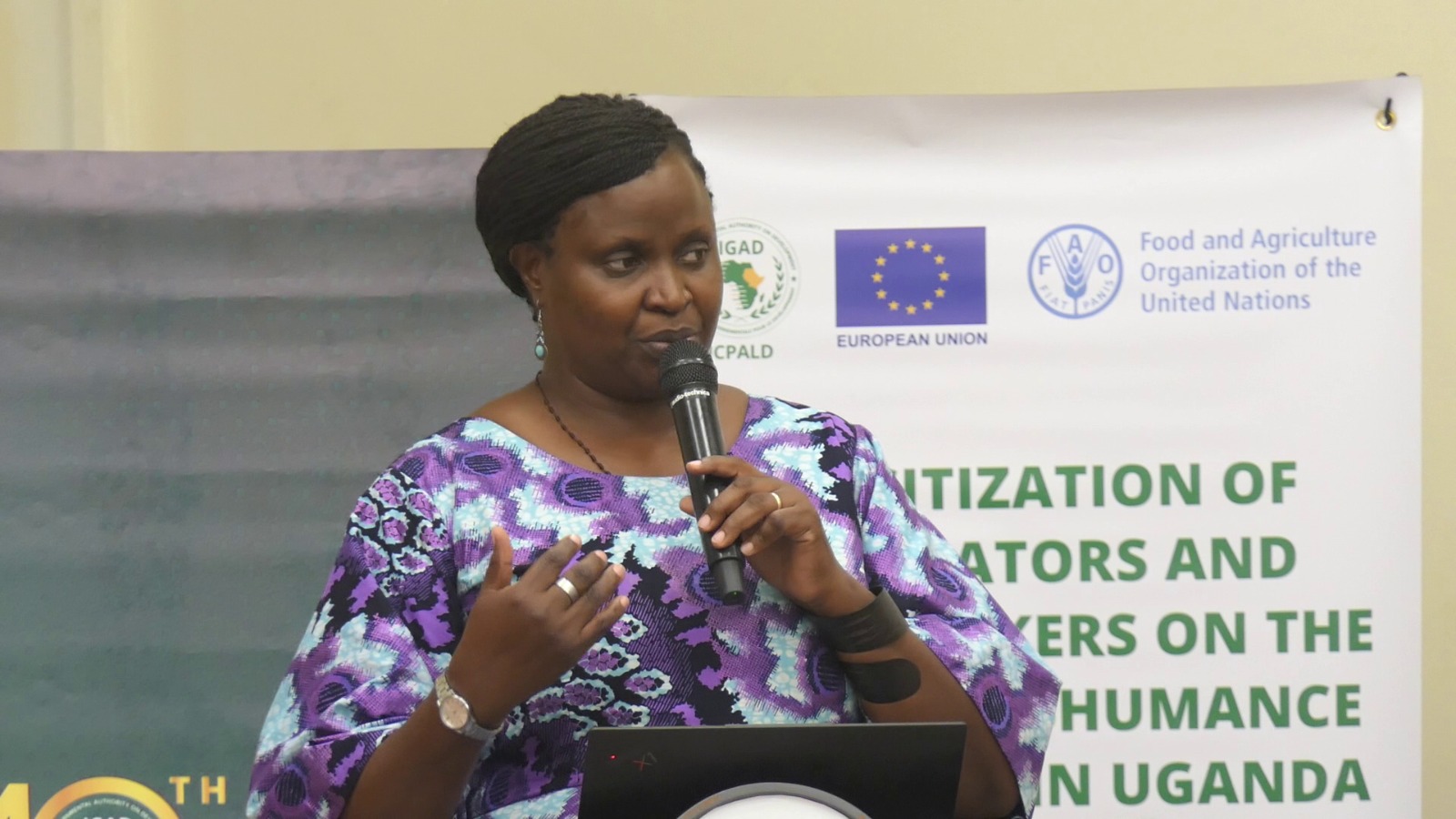
During the opening session, Ms. Joselyn Bigirwa, the IGAD Head of Mission to Uganda on behalf of the Executive Secretary in her welcoming remarks appreciated the
Government of Uganda through its Ministries and Agencies for their full participation on the consultations and development of the Protocol on Transhumance since 2017.
“Uganda’s signing, ratification, domestication and implementation of the Transhumance Protocol will help alleviate mobility related challenges such as trans-boundary diseases, animal theft, proliferation of illegal arms and intercommunal conflicts, while addressing border trade, joint resource management and utilization” Ms. Bigirwa added.
The meeting was officiated by Dr Namutebi Edith Nsubuga, the Head of Peace and Security Department, representing the Permanent Secretary, Ministry of Foreign Affairs Republic of Uganda.
She informed the meeting that the Republic of Uganda despite not signing yet, there have been significant efforts and contributions that were instrumental
in the negotiations and conceptualization of the Transhumance Protocol ensuring that it reflects the realities of the Horn of Africa.
“There is need for us to protect the traditional right of movement, modern ways of managing pastoralism ought to be considered.
We must integrate technology, improved
veterinary surveillance, and sustainable rangeland management into the implementation of this Protocol to ensure it meets the needs of a modern Uganda and the region at large” Dr. Namutebi added.
Additional remarks were by Hon. Christine Nakimwero Kaaya representing the Chair – Agriculture, Animal Industry and Fisheries Committee appreciated IGAD for prioritizing
pastoralists issues and welfare through ICPALD and pledged the technical team’s support towards the signing and ratification of the Protocol with great benefits to the pastoralist by strengthening and harmonizing policies for better access water and pasture, between complementary ecological areas within and between Member States.
Other remarks were by Hon. Phillips Lokwang Ilukol representing the Chair of Pastoralist Parliamentary Forum called on the implementation and domestication of the Protocol once its signed and ratified by engaging all stakeholders at grassroot levels of the different Member States to implement the Protocol and other bi lateral agreements
to benefit the pastoralists for economic and development of the pastoralist communities.
During the two-day meeting, the Protocol’s dissemination and popularization will be
enhanced in view of the existing policy frameworks, understanding of its benefits and engage stakeholders and advocate for national ownership.
Participation is by senior government experts from the Ministries responsible for Agriculture, Animal Industry and Fisheries (MAAIF), Presidential Affairs, Foreign Affairs, Water and Environment, Cabinet Affairs, Internal Affairs, Justice and Constitutional Affairs, Karamoja Affairs, and Office of the Prime Minister (OPM), and representatives from the corresponding Parliamentary Committees and Pastoralist Parliamentary Group/Caucus among others.